- 1401 Avocado Ave, Suite 104 Newport Beach, CA 92660,
- (949) 640-1320
- info@newportrx.com
- Monday - Friday: 9:00am-6:00pm | Saturday: 9:00am-2:00pm | Closed Sunday & Major Holidays

Walk into any pharmacy or scroll through your favorite retailer, and you’ll find hundreds of products claiming to reverse, slow, or prevent the signs of aging. From retinol serums and vitamin C creams to collagen supplements, hormone therapies, and prescription oral medications — the options are overwhelming, and the marketing language rarely gives you a clear picture of what actually works.
The truth is that aging affects the skin from both the outside and the inside. Topical skincare addresses surface-level changes — texture, tone, hydration, and visible fine lines. Oral medicines and systemic treatments work deeper, influencing cellular repair, hormonal balance, collagen synthesis, and inflammation throughout the body. Understanding the difference helps you make smarter choices about where to invest your time, money, and trust.
At Newport Center Compounding Pharmacy in Newport Beach, California, we work with patients and healthcare providers to offer both customized topical preparations and carefully selected oral anti-aging treatments. Here’s what you need to know.
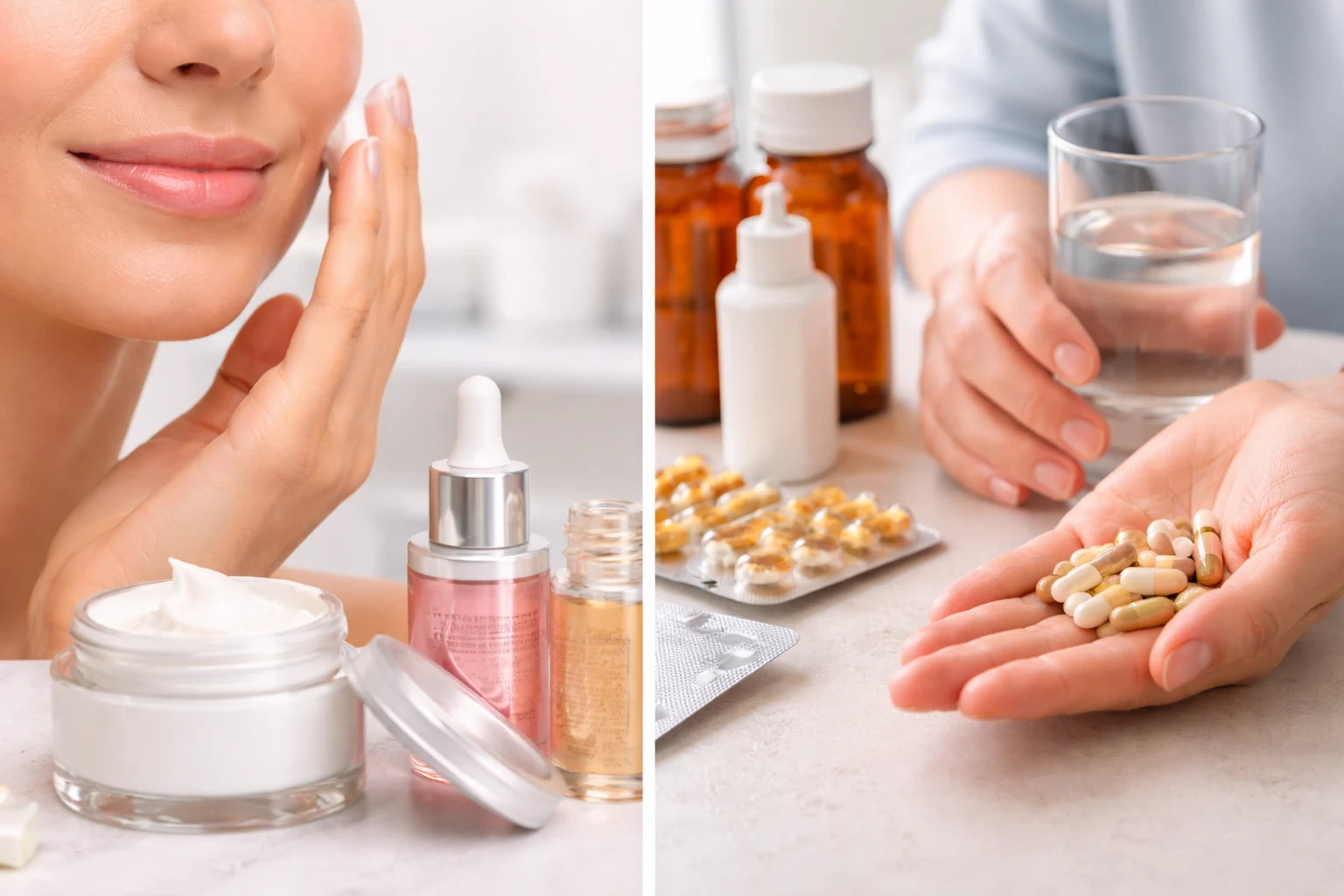
To evaluate which approach is more effective, it helps to first understand what aging actually does to skin. Skin aging happens on two levels:
Topical skincare is particularly well-suited to addressing extrinsic aging — surface damage that can be corrected by strengthening the skin barrier, boosting hydration, and neutralizing oxidative stress. Oral and systemic treatments are better equipped to tackle intrinsic aging — rebuilding from within by supporting hormones, cellular repair processes, and systemic inflammation.
Topical skincare has come a long way. When the right ingredients are used at the right concentrations, topical products can produce meaningful, visible improvements in skin appearance — especially for sun damage, uneven texture, and surface lines.
Retinoids (Retinol / Tretinoin)
The most evidence-backed topical anti-aging ingredient available. Retinoids stimulate collagen synthesis, accelerate cell turnover, and reduce the appearance of fine lines and pigmentation. Prescription-strength tretinoin delivers faster, more pronounced results than OTC retinol formulations.
Vitamin C (Ascorbic Acid)
A powerful antioxidant that brightens skin tone, reduces hyperpigmentation, protects against free radical damage from UV and pollution, and supports collagen production. Effective when used consistently in a stable, well-formulated serum.
Hyaluronic Acid
A hydration-binding molecule that can hold up to 1,000 times its weight in water. Helps plump fine lines, improve skin texture, and restore a youthful, dewy appearance. Works best as a daily moisturizing foundation for other active ingredients.
Niacinamide (Vitamin B3)
Reduces redness and blotchiness, tightens pores, and strengthens the skin barrier. A gentle, well-tolerated ingredient that works synergistically with most other actives in a skincare routine.
Peptides
Short chains of amino acids that signal the skin to produce more collagen. Effective in serums and creams for improving firmness and reducing the appearance of expression lines over consistent use.
Even the best topical ingredients work primarily at the skin’s surface layers. The epidermis acts as a barrier — and while many molecules can penetrate to the dermis, their ability to influence deep structural changes (like collagen remodeling throughout the dermis, hormonal shifts, or cellular aging processes) is limited. For patients dealing with significant skin laxity, deep wrinkles, hormonal skin changes, or systemic inflammation, topical skincare alone will rarely be sufficient.
Oral and systemic treatments address aging from a foundational level. Rather than treating the surface symptoms, they target the biological processes that cause the skin — and the body — to age in the first place.
One of the most significant drivers of visible aging, particularly in women, is the decline in estrogen and other hormones after perimenopause. Estrogen plays a critical role in skin hydration, collagen density, and elasticity. As levels drop, skin can become drier, thinner, and more prone to wrinkling — sometimes quite rapidly. Bioidentical hormone replacement therapy (BHRT) uses plant-derived hormones that are structurally identical to those the body produces naturally. For appropriate candidates, BHRT can restore hormonal balance, improve skin quality from within, increase energy, support mood, and address other symptoms of hormonal decline — providing benefits that no topical cream can replicate.
Not all supplements are created equal, but a few have genuine scientific support for their anti-aging effects:
For conditions like acne (which can accelerate skin aging), certain inflammatory skin diseases, or rosacea, prescription oral treatments — including low-dose antibiotics or hormonal medications — can address root causes that topical products alone cannot resolve. These require a healthcare provider’s evaluation and prescription.
The Compounding Advantage: Standard commercial medications come in fixed formulations. At Newport Center Compounding Pharmacy’s anti-aging service, we create customized preparations — combining the right ingredients, at the right doses, in the right delivery form — for each patient’s specific skin and health profile. This personalization is simply not possible with off-the-shelf products.
Topical Skincare
Oral / Systemic Medicines
The strongest anti-aging results consistently come from combining both approaches rather than choosing one over the other. Think of it as addressing aging from two directions simultaneously — topical treatments refine and protect the surface while systemic treatments rebuild and restore from within.
A well-designed combined plan might look like this:
The key is personalization. What works beautifully for one patient may not be appropriate for another, depending on age, skin type, hormonal status, health history, and specific concerns. This is exactly why working with a knowledgeable healthcare team — including a compounding pharmacist — makes such a meaningful difference. Explore the full range of compounding services available at Newport Center Pharmacy to understand all the ways personalized medication can support your wellness goals.
Commercial skincare products and standard medications are formulated for the average patient. Compounding pharmacy exists specifically to go beyond that — creating medications and preparations tailored to the individual.
At Newport Center Compounding Pharmacy, we partner with physicians and dermatologists to prepare:
This level of customization allows your treatment plan to fit your biology precisely — not the other way around. Our experienced practitioner team works closely with prescribing physicians to ensure every compounded preparation is safe, effective, and aligned with your health goals.
Neither is universally better — they address different aspects of aging. Topical skincare is most effective for surface-level changes like texture, discoloration, and fine lines. Oral and systemic treatments work at a deeper biological level, supporting hormonal balance, collagen production, and cellular repair. The most effective approach combines both, personalized to the individual’s age, health, and specific concerns.
Retinoids — including over-the-counter retinol and prescription-strength tretinoin — have the strongest evidence base among topical anti-aging ingredients. They stimulate collagen production, accelerate skin cell renewal, and reduce wrinkles and pigmentation with consistent use. Vitamin C, niacinamide, and hyaluronic acid are also well-supported by research as complementary actives.
Yes, with some important caveats. Several clinical studies have found that hydrolyzed collagen peptides taken orally can improve skin elasticity, hydration, and the appearance of wrinkles when taken consistently (typically 2.5–10 grams daily for at least 8–12 weeks). Results vary by individual, and oral collagen works best as part of a comprehensive regimen rather than a standalone solution.
Yes. Estrogen plays a significant role in maintaining skin collagen density, hydration, and elasticity. As estrogen declines during perimenopause and menopause, skin can thin and wrinkle more rapidly. Bioidentical hormone replacement therapy, when medically appropriate, can help restore hormonal balance and improve skin quality from within — a benefit that topical products cannot replicate on their own.
A compounding pharmacy creates customized medications tailored to the individual patient. For anti-aging, this can include custom-strength topical preparations with prescription-grade actives (such as tretinoin combinations), personalized bioidentical hormone formulations, and oral supplements compounded to specific dosages. This level of personalization allows treatments to be precisely matched to the patient’s biology and health needs rather than using standard commercial formulas.
Safety depends on the specific medication, dose, and the individual’s health profile. Oral supplements like collagen, omega-3s, and vitamins are generally well-tolerated. Hormonal therapies and prescription medications require evaluation by a licensed healthcare provider, as they carry potential interactions and contraindications that must be assessed individually. Always work with a qualified physician and pharmacist when considering systemic anti-aging treatments.
Timelines vary by treatment type. Topical retinoids typically show noticeable improvement in texture and tone within 6–12 weeks. Hydration-focused ingredients like hyaluronic acid can show effects within days. Oral collagen supplements generally require 8–12 weeks of consistent use. Hormonal therapies may take several weeks to months before full skin benefits are apparent, though other systemic benefits (energy, sleep, mood) are often noticed sooner.
Recent Post