- 1401 Avocado Ave, Suite 104 Newport Beach, CA 92660,
- (949) 640-1320
- info@newportrx.com
- Monday - Friday: 9:00am-6:00pm | Saturday: 9:00am-2:00pm | Closed Sunday & Major Holidays

When filling a prescription, most people visit a regular retail pharmacy without realizing that another specialized option exists, the compounding pharmacy.
Understanding the difference between a compounding pharmacy vs regular pharmacy is important, especially for patients who need customized medications, alternative dosage forms, or solutions not available in standard drug products. Both types of pharmacies play essential roles in healthcare, but they serve different patient needs.
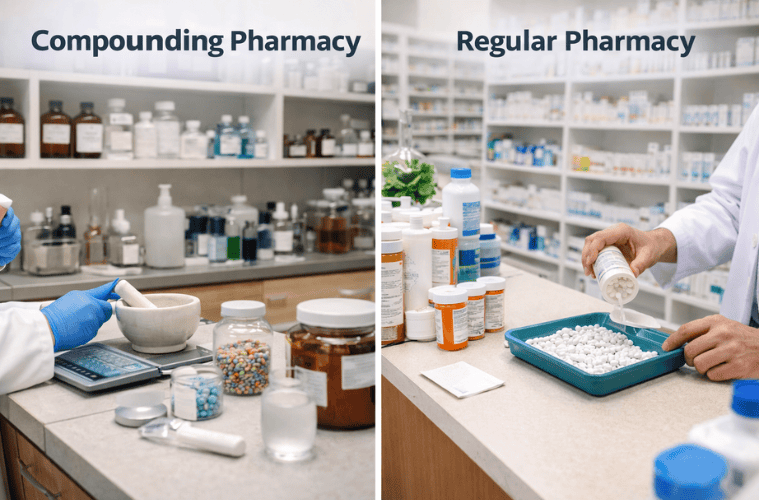
A regular pharmacy, also known as a retail pharmacy, dispenses commercially manufactured medications that are mass-produced by pharmaceutical companies. These medications are approved by regulatory authorities and come in standard strengths, dosage forms, and packaging. Retail pharmacies focus on:
Most patients use regular pharmacies because they offer convenient access to widely available medications for common conditions such as infections, high blood pressure, or diabetes
A compounding pharmacy specializes in custom medications tailored to individual patient needs. Compounding pharmacists prepare personalized medications by combining, mixing, or altering ingredients based on a doctor’s prescription. Compounding is often necessary when:
This process is called prescription compounding, and it allows pharmacists to create personalized medicine solutions.
Recent Post
| Feature | Compounding Pharmacy | Regular Pharmacy |
|---|---|---|
| Medication Type | Prepares customized medications tailored to individual patient needs | Dispenses mass-produced, commercially available medications |
| Personalization | Fully personalized based on doctor’s prescription | Standard medications with fixed strengths and forms |
| Dosage Flexibility | Can create specific strengths not available commercially | Limited to manufacturer-produced dosages |
| Dosage Forms | Can prepare creams, gels, liquids, capsules, injections, suppositories, etc. | Typically provides tablets, capsules, syrups, and standard forms |
| Allergy-Friendly Options | Can remove allergens such as dyes, gluten, lactose, or preservatives | Limited ability to modify ingredients |
| Specialized Treatments | Commonly used for hormone replacement therapy (HRT), pediatric, and veterinary compounding | Focuses on general prescription medications |
| Availability | Can recreate discontinued or unavailable medications | Cannot create or modify unavailable medications |
| Patient Suitability | Ideal for patients needing personalized or alternative medication forms | Suitable for most patients with standard prescription needs |
| Preparation Method | Medications are prepared by licensed compounding pharmacists | Medications are manufactured by pharmaceutical companies |
| Purpose | Provides customized medication solutions for unique medical needs | Provides convenient access to standard medications |
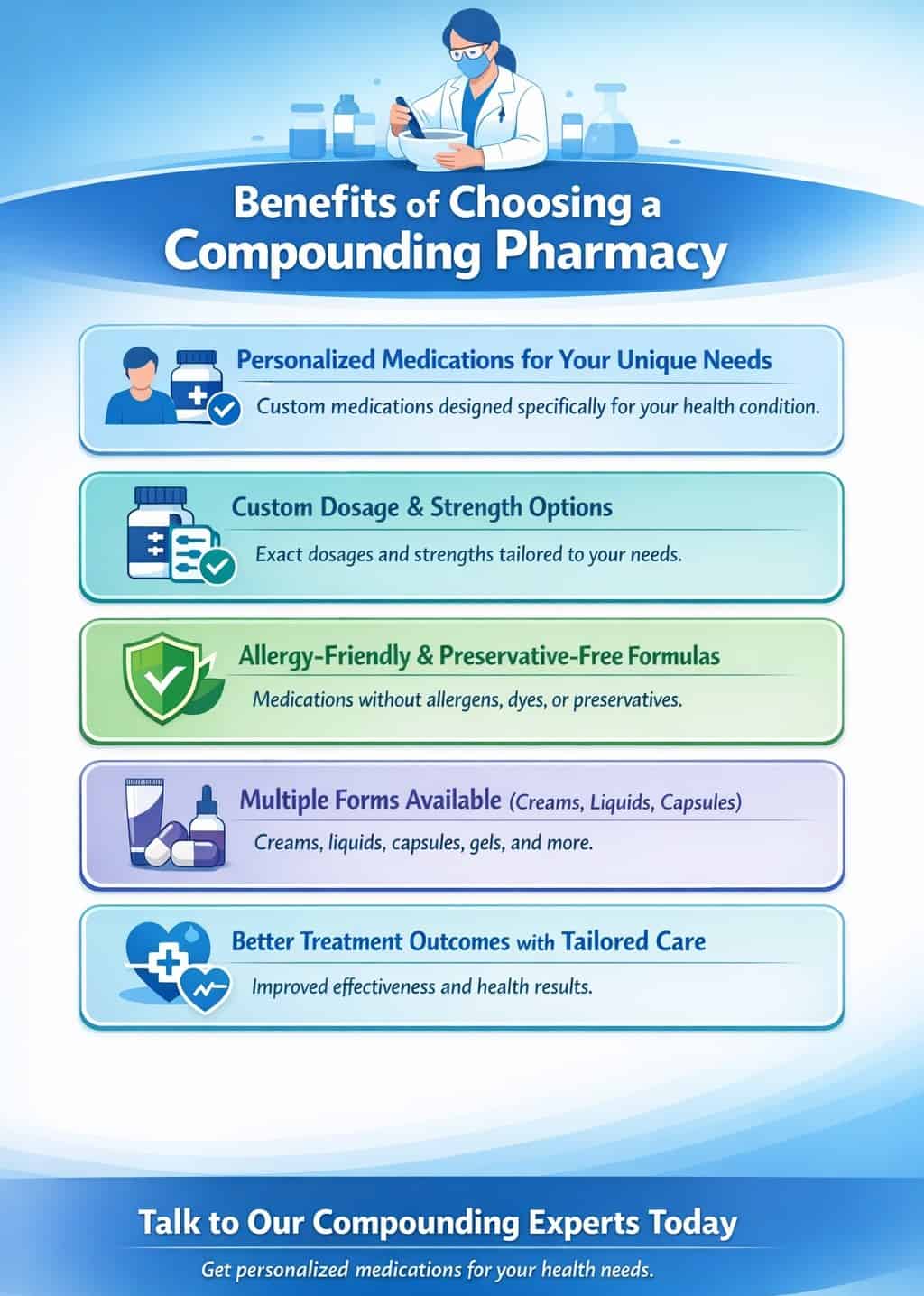
Choosing a compounding pharmacy offers personalized medication solutions tailored to your specific health needs. Unlike standard pharmacies, compounding pharmacies can adjust dosage strength, combine medications, and create customized forms such as creams, liquids, or capsules.
The key benefits of compounded medication include personalized dosage, improved absorption, and customized formulations tailored to each patient’s unique needs. This ensures safer, more effective treatment for patients with unique medical requirements or sensitivities. A local compounding pharmacy offers several advantages, including:
Compounded medications are especially beneficial for patients with chronic conditions, hormone imbalances, or specific medical requirements.
You should use a compounding pharmacy when standard medications do not meet your specific medical needs. Compounding pharmacists can customize dosage, remove allergens, or create alternative forms like liquids or creams for easier use. Compounded medications are game changers for treating wounds because they provide personalized solutions that promote faster healing and better comfort. You may benefit from using a compounding pharmacy if:
Healthcare providers often recommend compounding pharmacies when personalized treatment is necessary.
Both compounding pharmacies and regular pharmacies serve important roles in healthcare. Regular pharmacies provide convenient access to standard medications, while compounding pharmacies offer customized medication solutions tailored to individual patient needs.
If you require personalized medicine, specialized dosage forms, or allergy-free medications, Newport Beach Pharmacy may be the best choice. Contact us today by calling (949) 640-1320 to ensure you receive safe, effective, and customized treatment designed specifically for you.
FAQS- Compounding Pharmacy vs. Regular Pharmacy
What is the main difference between a compounding pharmacy and a regular pharmacy?
A regular pharmacy dispenses mass-produced medications approved by manufacturers, while a compounding pharmacy creates customized medications tailored to individual patient needs. Compounding pharmacies can adjust dosage, ingredients, and form based on a doctor’s prescription.
Why would someone choose a compounding pharmacy instead of a regular pharmacy?
Patients choose compounding pharmacies when they need personalized medications, such as allergy-free formulas, specific dosage strengths, or alternative forms like creams or liquids that are not available commercially.
Are compounded medications safe?
Yes, compounded medications are safe when prepared by licensed pharmacists following strict quality and safety standards. Compounding pharmacies comply with state pharmacy boards and USP (United States Pharmacopeia) guidelines to ensure patient safety.
Can compounding pharmacies make medications that regular pharmacies cannot provide?
Yes, compounding pharmacies can create customized medications that are not available in standard pharmacies, including discontinued medications, unique dosage strengths, and specialized treatments for specific health conditions.
Do compounding pharmacies require a prescription?
Yes, compounded medications require a valid prescription from a licensed healthcare provider. The pharmacist prepares the medication according to the doctor’s specific instructions.
Are compounded medications more expensive than regular medications?
Compounded medications may cost more because they are customized and prepared individually. However, the cost depends on the ingredients, complexity, and insurance coverage.
Who benefits most from compounding pharmacy services?
Compounding pharmacies are especially beneficial for children, seniors, patients with allergies, individuals needing hormone therapy, and those requiring personalized treatments that are not available commercially.
Can compounding pharmacies change the form of medication?
Yes, compounding pharmacies can convert medications into easier-to-use forms such as liquids, topical creams, gels, or flavored medications for better patient comfort and compliance.