- 1401 Avocado Ave, Suite 104 Newport Beach, CA 92660,
- (949) 640-1320
- info@newportrx.com
- Monday - Friday: 9:00am-6:00pm | Saturday: 9:00am-2:00pm | Closed Sunday & Major Holidays


One of the hardest questions a family can face is knowing when to shift from pursuing aggressive treatment to focusing on comfort and quality of life. There is no single right answer — but there are clear signals. Understanding those signals can help you make one of the most important and compassionate decisions of your life.
Hospice care is not about giving up. It is about choosing a path that honors the patient’s dignity, reduces suffering, and allows meaningful time with loved ones. Yet many families wait too long before making this transition — sometimes because of fear, uncertainty, or the hope that the next treatment will turn things around.
The truth is, earlier access to hospice almost always leads to better outcomes: less pain, fewer distressing hospitalizations, and more time at home. In this article, we will walk through the key signs that it may be time to consider hospice care, and how compassionate support — including personalized medication management — can make all the difference.
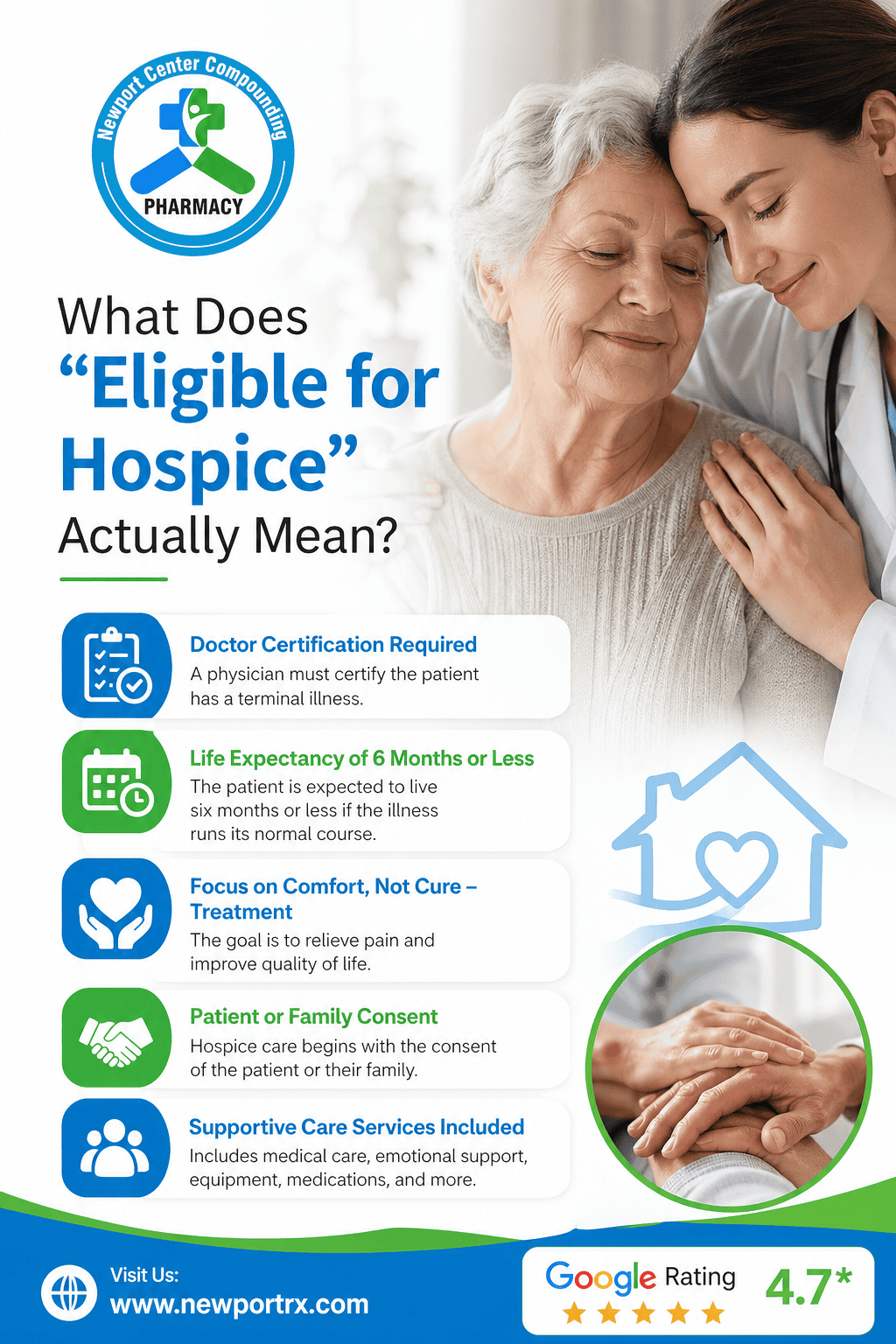
In the United States, hospice care is typically available when a physician determines that a patient has a life expectancy of six months or less if the illness runs its natural course. This is the standard used by Medicare, Medicaid, and most private insurers to qualify patients for hospice benefits.
It is important to understand that this is not a countdown clock. Patients can remain in hospice longer than six months if their condition stays stable. And if a patient’s health unexpectedly improves, they can always leave hospice and return to curative treatment — or re-enroll later if needed.
Important: You do not have to wait until a patient is in crisis to begin hospice. The earlier the conversation starts, the more time everyone has to benefit from coordinated, compassionate care.
Every patient’s journey is unique, but certain patterns tend to signal that the focus of care should shift. Here are the most important signs to watch for:
When a patient is cycling in and out of the hospital — especially for the same recurring issues — it is often a sign that curative treatment is no longer working effectively. Repeated emergency visits are exhausting for patients and families alike.
A noticeable and continuing decline in the ability to perform daily activities — walking, dressing, eating independently — is a meaningful indicator that the illness is progressing despite treatment.
When pain, breathlessness, nausea, or other symptoms are difficult to manage and are significantly reducing quality of life, hospice’s specialized focus on symptom control can offer real relief that standard care cannot always provide.
Unexplained or persistent weight loss, loss of interest in eating, and difficulty swallowing are signs that the body is using energy differently — often a sign of advanced illness progression
If curative treatments — chemotherapy, dialysis, surgery — are no longer improving the patient’s condition or are causing more suffering than benefit, it may be time to reassess goals of care.
When the patient themselves expresses a desire to stop aggressive treatment and prioritize comfort, that wish deserves to be heard and respected. Patient-directed care is at the heart of the hospice philosophy.
None of these signs on its own necessarily means hospice is the right choice. But when several of them appear together — or when a physician raises the subject — it is a strong signal that the time has come to have an open, honest conversation.
Bringing up hospice can feel daunting, but avoiding the conversation often means missing the window for the best possible care. Here are some practical ways to approach it:
Conditions That Commonly Lead to Hospice Enrollment
While hospice is often associated with cancer, it serves patients with a wide range of serious, life-limiting illnesses. Common conditions that may eventually call for hospice care include:
What these conditions have in common is that they reach a point where the body can no longer respond meaningfully to curative intervention. At that stage, the most important thing a care team can do is ensure the patient is as comfortable, supported, and present as possible.
💊Hospice patients have evolving and highly individual medication needs. At Newport Center Compounding Pharmacy, we work directly with hospice teams to prepare custom medications — transdermal gels, liquid suspensions, allergen-free formulations — tailored to each patient’s condition.
Our pain management specialists understand that comfort is not one-size-fits-all.
As illness progresses, patients often find that standard medications no longer work for them — they may not be able to swallow pills, they may develop sensitivities to certain ingredients, or they may need a dosage combination that commercial drugs simply cannot provide.
This is where a compounding pharmacy becomes an invaluable part of the hospice team. Compounding allows pharmacists to prepare medications from scratch in forms that directly match the patient’s needs at any given stage of their illness. A few examples of how this helps hospice patients:
The experienced practitioners at Newport Center Compounding Pharmacy have over 25 years of expertise creating personalized pharmaceutical solutions. They work closely with physicians and hospice providers to ensure each patient’s medication plan evolves right alongside their care.
Once a patient is enrolled in hospice, a dedicated interdisciplinary care team takes over coordination of their comfort-focused care. This team typically includes a hospice physician or medical director, registered nurses who visit regularly, a social worker, a chaplain or spiritual counselor, home health aides, and trained volunteers.
The hospice team does not replace family members — it empowers them. Caregivers receive education on how to manage day-to-day needs, what changes to expect, and who to call at any hour if something urgent arises. Most hospice programs maintain a 24/7 nurse line exactly for these moments.
Medical equipment — such as a hospital bed, wheelchair, or oxygen — is typically delivered directly to the home. Medications related to the terminal diagnosis are covered under the Medicare hospice benefit. Families can focus on being present rather than managing logistics.
And when the time comes, hospice continues to support the family through bereavement services — often for up to 13 months after the patient’s passing.
What is hospice care and who is it for?
Hospice care is specialized medical care focused on comfort, quality of life, and emotional support for patients with serious or terminal illnesses, typically when curative treatment is no longer effective or desired.
When should someone consider hospice care?
Hospice care should be considered when a doctor estimates a life expectancy of six months or less, or when a patient’s condition is declining despite ongoing treatment, and the focus shifts to comfort rather than cure.
What are the key signs that hospice care may be needed?
Common signs include frequent hospitalizations, worsening symptoms, significant weight loss, increased fatigue, difficulty with daily activities, and a desire to stop aggressive treatments.
Can hospice care be provided at home?
Yes, hospice care is often provided at home, allowing patients to remain in a familiar and comfortable environment while receiving medical, emotional, and spiritual support.
Does choosing hospice mean giving up all medical treatment?
No, hospice care focuses on palliative treatment—managing pain and symptoms—rather than curing the illness. Patients still receive medical care aimed at comfort and quality of life.
Can a patient leave hospice care if their condition improves?
Yes, patients can leave hospice care at any time if their condition stabilizes or improves, or if they decide to pursue curative treatment again.
How does hospice support families and caregivers?
Hospice provides emotional counseling, respite care, education, and bereavement support to help families cope during the patient’s illness and after their passing.